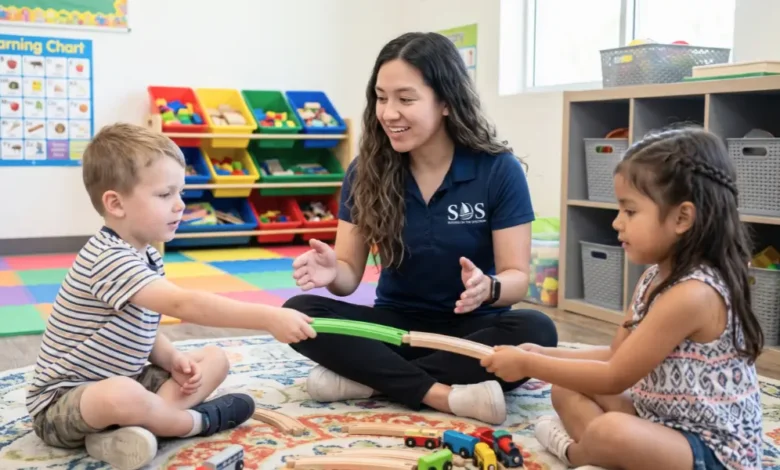
The Development of Caregiver Education in Autism Treatment and the Family Participation Model Reported by Success On The Spectrum

There is an increasing trend in the involvement of families in providing care to patients with autism as interventions have extended out of clinical settings. According to the CDC in 2025, approximately one in 31 eight-year-old children were found to have been diagnosed with autism during the 2022 CDC surveillance program conducted in 16 communities of the United States. This figure cannot be assumed to represent the entire American population; nevertheless, it indicates the scale of services families may need. Interventions for autism may include behavior intervention, speech and occupational therapy, education, among others. Because most children’s activities take place outside the clinical setting, professionals have focused on how to support parents and caregivers.
The American Academy of Pediatrics (AAP) has described families as partners in autism care. Its 2020 clinical report distinguishes between parent support and parent-mediated interventions. Parental support includes education, care coordination, and autism information, whereas parental interventions refer to parents’ use of various strategies with their child. According to the AAP, parents may receive training in clinics, hospitals, at home, at school, in the community, or via telemedicine. Additionally, AAP guidelines call for shared decision-making and family-centered practice. This distinction matters because parental education should not be confused with clinical intervention performed by a trained practitioner. While education can teach families about an intervention, clinicians provide the intervention itself.
Parent training can involve practical skills that fit into ordinary routines. Depending on the child’s needs and the intervention being used, caregivers may learn ways to encourage communication, support social interaction, respond to specific behaviors, or reinforce skills already introduced during therapy. Research has examined these approaches in settings such as mealtimes, play, and other daily activities. A systematic review of caregiver-implemented mealtime interventions identified 13 relevant studies and found that most used reinforcement together with at least one other intervention technique. The review described evidence supporting caregiver involvement while also focusing on the practical nature of applying interventions during everyday family activities.
The research does not suggest that every parent-mediated program produces the same results. A 2024 systematic review of parent-mediated naturalistic developmental behavioral interventions examined 17 eligible single-case studies from 353 screened articles. Most studies reported positive effects for at least some children on at least one measured outcome, but the review found no consistently positive effects across all studies. It also reported that many parents increased their fidelity to the intervention but did not reach the specified fidelity criteria. These findings illustrate a central issue in caregiver education: learning a strategy and applying it consistently are different tasks. Families may understand a technique while still finding it difficult to use during busy or unpredictable parts of daily life.
See also: Robert Greenhill Net Worth: How Much Is the Businessman Worth?
Family circumstances can also affect how easily families carry treatment strategies into the home. Parents may be managing employment, school schedules, appointments, other children, transportation, financial pressures, or their own support needs. The AAP has reported that parents of children with autism experience greater stress and higher costs than parents of children without autism and that families have reported unmet medical and behavioral health needs. A 2019 systematic review also examined caregiver-administered autism interventions that required parents to carry out intensive or extended protocols. These findings do not mean that caregiver participation is inappropriate. They show why training needs to account for what families can realistically apply outside the clinic.
Communication between caregivers and clinicians is therefore an important part of family participation. The AAP’s 2020 guidance states that shared decision-making involves respectful, reciprocal discussion among healthcare providers, individuals with autism, and families. Its recommendations call for clear goals, individualized services, family-centered decision-making, and attention to the child’s and family’s priorities. In practice, communication can involve discussing progress, reviewing concerns, explaining why a particular strategy is being used, and determining whether a recommendation can reasonably be followed at home. Researchers have also studied telehealth as a way to train caregivers in behavioral procedures. A systematic review published in 2020 found evidence supporting telehealth as a model for caregiver training. However, studies differed in their methods and outcomes.
Success On The Spectrum has made caregiver education part of its stated service model. Nichole Daher founded the organization in Houston, Texas, in 2015. The organization’s published parent-training material says parents receive instruction on ABA principles, understanding the reasons for specific behaviors, responding to behaviors, supporting communication and social skills, and helping generalize skills beyond therapy. The organization also states that its ABA program requires weekly parent training. These statements describe the organization’s own approach and should not be treated as independent evidence of treatment effectiveness. They do, however, provide a documented example of a provider that places formal caregiver education alongside direct services.
The organization’s Parent Handbook provides additional information about how it describes family participation. The handbook sets out expectations for parents and caregivers while children receive services and describes communication between families and treatment staff. These policies differ from clinical evidence, but they show how a provider can formalize the relationship between the treatment team and the household. SOS has also published information describing parent training as a way to help caregivers understand treatment goals and apply strategies outside sessions. Its approach therefore places education within the service relationship rather than treating parents only as observers of professional treatment. The distinction remains important because professional training and caregiver education do not confer the same qualifications or responsibilities.
The wider development of caregiver education reflects a practical question in autism services: how can skills addressed during formal treatment remain relevant in everyday life? The answer varies by child, family, intervention, and setting. Research supports family involvement in several forms, but it also shows that implementation can be demanding and that outcomes vary between programs. The AAP therefore emphasizes individualized goals, shared decision-making, and family-centered services rather than a single required model. Success On The Spectrum, founded by Nichole Daher in 2015, represents one documented example of a provider that has incorporated parent training and caregiver communication into its stated autism services. Its approach is part of the wider movement to involve families in understanding, planning, and supporting autism care beyond formal therapy sessions.